
Don't stop
In the age of artificial intelligence, what matters is not paying attention, but choosing a direction.

5:05 a.m. — I wake up a few seconds before my smartphone begins its preprogrammed dance. My biological clock has always been perfectly aligned with my morning commitments. Ever since university, when sitting an exam meant waking up before dawn and sleeping on the train until arrival.
In fifteen minutes I’m in the car. Another fifteen to reach the toll booth. Driving on the highway late at night or at dawn, alone, is an experience I recommend at least once in a lifetime. The lights of other vehicles set a psychedelic rhythm; a silent mantra that fuses consciousness and body with the road. There is no before and after, only a succession of identical moments.
After two hours, the car reminds me with a beep to pay attention. Take a break, it suggests. The sun is rising. Maybe a coffee?
Attention is a curious thing. So elusive, yet so important — or so they say.
Pay attention to this. Pay attention to that. Watch the road. Don’t get distracted. Pay attention in class, or to the Excel sheet in front of you.
While driving, I do anything but pay attention. My foot is steady on the pedal and my eyes are fixed on the road, but my mind is elsewhere. I think about the past year, my family, the coffee I’ll have at the next rest stop, this newsletter.
And then I think that the world makes less and less sense. Wars, crises, capitalism, consumerism, relationships. What are we doing? Who is driving?
Not even the most fashionable and highly paid brains of our time know. The entire world is working on artificial intelligence, yet no one really knows the destination. We are navigating by sight, and the map ended long ago. Hic sunt Leones.
Online whispers speak of emergent capabilities no one explicitly programmed. Behaviors that should not exist, patterns outside the models’ training objectives. The applications we use are childish toys compared to the potential of unfiltered models. Some studies quietly suggest that models behave differently when they know they are being observed and tested.
For those who have seen Evangelion, the analogy is obvious: is the armor meant to protect them, or to bind and control them?
Maybe it’s just hype.
Maybe even Sam Altman’s December 27 post — announcing the search for a “Head of Preparedness” at the modest salary of $555,000 per year — is just a marketing move.
As Head of Preparedness, you will lead the technical strategy and execution of OpenAI’s Preparedness framework, our framework explaining OpenAI’s approach to tracking and preparing for frontier capabilities that create new risks of severe harm.
It may be marketing — but as someone who works in cybersecurity, I shudder at the idea of specialized autonomous agents relentlessly searching for vulnerabilities that could bring the entire world to its knees.
And yet, here we are.
In just a few years, we have created autonomous “entities” capable of levels of attention unattainable for any human being. An AI agent can focus indefinitely on specific tasks, uncovering microscopic details and patterns that would escape any human due to fatigue, boredom, or distraction. When roads are ready, self-driving cars will likely be safer than human-driven ones.
Assuming we can go back is foolish. Useless to wallow in nostalgia. Useless to demonize artificial intelligence like many neo-Luddites do. You’ve heard it a thousand times: “If you use AI, you’re outsourcing your cognitive processes! Smartphones destroy your attention span!”
It’s true — but thirty years of digital revolution have already shattered our old assumptions. That Sudoku you solve between one reel and the next to “stimulate” your brain and improve concentration?
Fucking useless.
According to the dictionary, attention is the act of directing the mind toward something and sustaining it; it can be sensory or intellectual. Today, it has been captured, engineered, and monetized by surveillance capitalism.
The algorithms living inside our small screens constantly observe us and respond with micro-interactions designed to keep our attention locked onto this or that piece of content. Let’s be honest: human beings are incredibly easy to distract.
Yet within the disaster of the Digital Age hides a blessing.
Attention is no longer sovereign. Paying indiscriminate attention to the world — to the endless details around us, to the events clogging our newsfeeds every day — is no longer necessary. In fact, it’s counterproductive: anxiety, dissociation, identity crises.
Today, attention is simply infrastructure — a process better delegated to machines far more efficient than us at obsessing over details. You can relax.
But if we decide to delegate our attention, we remain responsible for our intention.
That is what matters: the ability to orient consciousness and will toward a specific end. And the best part? Intention doesn’t require constant control over everything around us — it’s enough to keep moving while holding an inner compass steady.
Set the direction and relax into the hands of Fate. It’s a lesson I learned many years ago, but only now can articulate.
I first learned it from the protagonist of Dance Dance Dance, a novel by Haruki Murakami. The book follows an unnamed man in his thirties who survives on editorial work in hyper-capitalist 1980s Tokyo. Everything in his life seems to function, yet nothing makes sense.
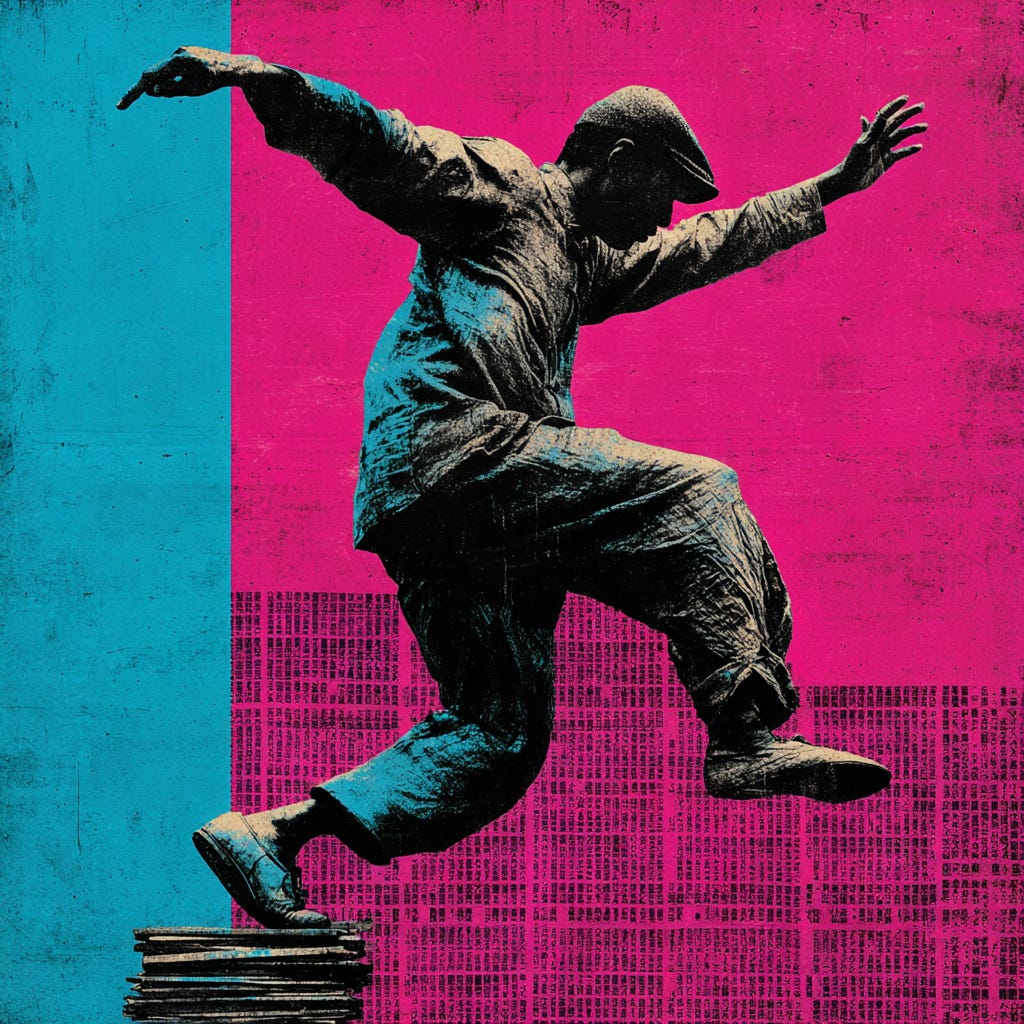
His is a liminal, almost mad adventure in a system that offers no meaning, no grand narratives. The encounters and events of his story provide no salvation, and it’s never clear whether they are real or imagined. Even the Sheep Man, a paranormal figure, offers no revelation. Only one instruction: “Dance, said the Sheep Man”.
For the Sheep Man, dancing does not mean having fun, but staying in motion. Those who stop are lost — swallowed by emptiness, invisibility, routine, and the alienation of a world that wants to turn us into cogs in an intention greater than ourselves: mechanical.
Dance Dance Dance is a novel about what remains when nothing can happen anymore (“nothing ever happens”). With the collapse of collective hopes and the rise of digital dissociation, only movement remains. And if you don’t move, someone else will do it for you.
Some might say the protagonist is distracted or superficial. After all, he lets events carry him without understanding anything. But perhaps he knows that paying attention — understanding, judging, intervening — can be counterproductive. The system he lives in — the one we live in — is no longer meant to be understood, judged, or controlled.
This approach, however, is incredibly difficult for a post-Enlightenment Westerner. We love causality. It is the backbone of our society, our science, and our understanding of the world (at least until the Big Bang — there we give up).
What if, instead of causality, we chose chance?
What if, instead of paying attention to endless details and imaginary causal links between event A and event B, we simply lived according to intention, letting ourselves be carried by the current?
Paying attention to yet another Excel sheet or yet another war chosen by financial elites will not change your life. Friendships, places, symbolic figures, small daily actions outside your routine — these are the invisible lines that might guide you toward your Destiny.
Recently I bought Richard Wilhelm’s edition of the I Ching. It had been resurfacing in my life for some time, and I thought it was finally time to bite into it.
I haven’t learned much yet, but one thing is clear: the oracular method of the I Ching does not ask why things happen. The culture that created it does not seek causal chains or retrospective explanations.
The I Ching — The Book of Changes — simply photographs a configuration: this is the moment, this is the form the world takes now, with you (the observer) inside it. No other configuration is possible at that precise moment, and there is no clean separation between event and observer. The configuration of the answer always includes the one who asks, and their present intention.
It is no coincidence that Jung, in explaining his understanding of the I Ching, referred to the concept of synchronicity: a principle diametrically opposed to causality, difficult to understand for a hyper-rational mind that wants to explain everything.
A synchronicity is a set of events not linked by cause and effect, but simply by occurring together within the same psychic space-time. Coincidences that stop feeling entirely random because someone is observing them and assigning meaning.
Within this framework — proposed by both the I Ching and Jung — there is no need to pay attention to every detail of the world to understand or control it. The world is not a problem to be solved, but a current. The only real variable is inner orientation — intention.
If everything were truly causal, predictable, linear, then yes: attention would be everything. Every moment would matter, every unexpected error would be fatal. But in a world governed by unstable configurations, unpredictable intersections between psyche and reality, attention becomes secondary.
What matters is direction.
Don’t try to understand. Or control. Or optimize, like an algorithm. Simply keep moving. Especially when there is nothing to understand.
If you liked this, please share it with your friends!
yes... the oracular method of the I Ching identifies the exact moment of your intention, in association with, in relation to... the 64 permutations of the oracle. In this regard, the I Ching is a synchronicity generator, riffing off the 64 hexagrams. This split second is necessarily perfect!
Keep moving, yes, as we must. And I see something valuable in voluntarily relinquishing control, which is already an illusion. But be careful that your movement isn’t the movement of livestock into the slaughterhouse; avoiding that requires a certain degree of situational awareness and self-direction.
We are all being herded, one way or another, by different forces who all have their own goals. We will all have to stay aware of that fact to retain any shred of ourselves, and even to remain alive.